
Dresden SKD Münzkabinett "Crypto, what?": From a 1587 Cipher Device to Bitcoin — A Museum Experiment on Digital Currency
What does a 16th-century coding device have to do with Bitcoin? And how can the history of paper money help us understand today’s stablecoins? The word "crypto" appears constantly in news headlines, on social media and in advertising, yet between technical jargon, price alerts and get-rich-quick fantasies, what it actually means remains vague to most people. The Münzkabinett (Coin Cabinet) of the Staatliche Kunstsammlungen Dresden (SKD) addresses this question head-on with a special exhibition.
A year-long lesson in money
"Crypto, what?" runs from 3 October 2026 to 29 August 2027 and tackles a topic of enormous influence in our era that remains a mystery to many. The exhibition invites visitors to reflect on digital value against the historical backdrop of technology and currency, showing how encryption, automated data processing and global networking converge in the Bitcoin system.
For thousands of years, people have tried to hide secret messages with codes and to automate complex mathematical calculations. The exhibition brings together several key examples: a substitution cipher device from 1587, a replica built after a calculating machine designed by Gottfried Wilhelm Leibniz in the early 18th century, and a 20th-century Enigma cipher machine. The thread reaches back to long before the internet — but only once computers became faster and could connect to a global network were digital payment processes invented and the concept of digital currency became a viable reality.

Framing blockchain as the next chapter of monetary history
The exhibition explains basic concepts such as blockchain, public and private keys, wallets and mining, shows how networked computers verify transactions, and details the difference between home-based Bitcoin mining and the industrial mining race. On top of Bitcoin, a diverse crypto market has formed. Coins, tokens and stablecoins differ in technology, function and use — not everything pushed onto the market as a crypto asset is designed for long-term or serious use.
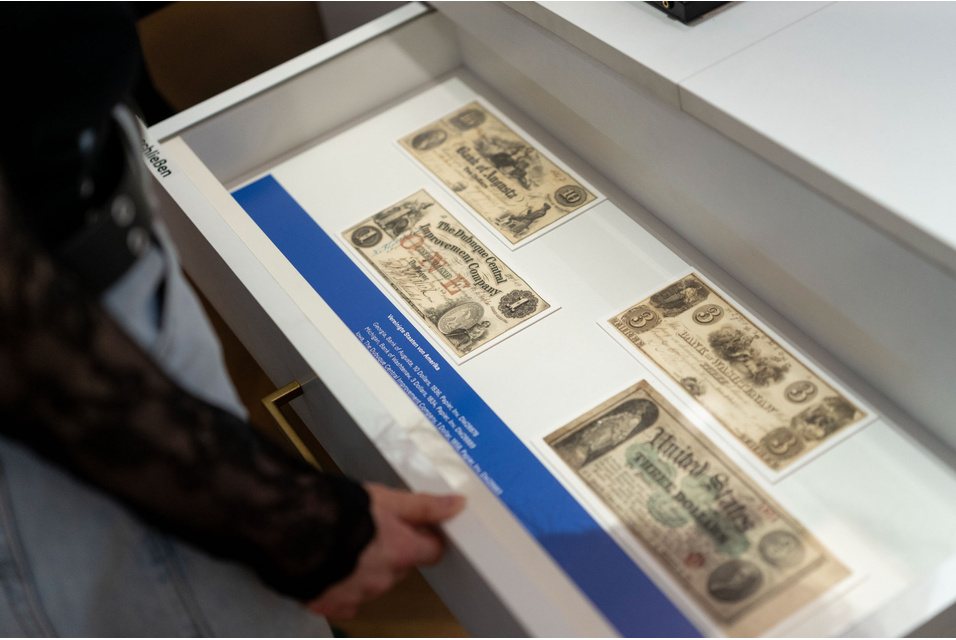
By drawing analogies from monetary history, the exhibition reveals the tension between original ideals and real-world effects. Through several surprising examples, it shows how historical currencies and today’s crypto assets raise similar questions: what determines value? what rules apply? how is trust established? and who bears the risk?

The Münzkabinett’s distinctive position
This is precisely where the Dresden Coin Cabinet can make a unique contribution. As one of the world’s most important collections of coins and medals, it holds a physical sequence of money spanning thousands of years, and is naturally equipped to place Bitcoin back into the long river of monetary history.
This kind of exhibition also marks a shift in contemporary museums: rather than shying away from hotly debated yet hard-to-grasp technological topics, they use their collections as anchors to build comprehensible historical coordinates. SEEEEART will continue to follow museums’ curatorial practice on technology subjects.
Disclaimer: Except for original works, the articles, images, videos and music used on this platform belong to their respective rights holders. Due to unavoidable circumstances, some content may be used without proper attribution. If you are a rights holder and your work has been used without permission or with incorrect credit, please contact us and we will correct it promptly. We are committed to maintaining a healthy creative environment.
